
FibroScan in Hyderabad
Introduction
FibroScan in Hyderabad is a non-invasive liver assessment that can provide useful information about liver stiffness and estimate liver fat. It may be recommended for people with suspected fatty liver, certain chronic liver conditions, abnormal liver-related test results, or other relevant risk factors.
The liver performs many essential functions, including supporting metabolism, processing nutrients, storing energy, and helping manage substances in the bloodstream. Because some liver problems can develop gradually without obvious symptoms, appropriate monitoring can play an important role in healthcare.
Early detection does not mean that every abnormal result indicates serious disease. Instead, timely assessment can help healthcare professionals understand possible changes and decide whether additional evaluation or follow-up is needed.
FibroScan in Hyderabad can be one part of this broader assessment. It measures liver stiffness and can provide a CAP measurement that estimates liver fat without requiring a tissue sample.
This guide explains how FibroScan works, why early liver monitoring matters, how to prepare, what happens during the procedure, how results are interpreted, and how the examination can fit into better liver care.
Why Early Liver Detection Matters
Many liver-related conditions may develop slowly. A person may not always experience clear symptoms during the early stages.
This is one reason healthcare professionals may recommend appropriate screening or monitoring for people who have specific risk factors.
FibroScan in Hyderabad can provide objective measurements that may help doctors assess liver stiffness and estimated liver fat when clinically appropriate.
Early assessment can also encourage people to pay greater attention to related health factors such as body weight, blood sugar, cholesterol, diet, physical activity, and alcohol consumption.
Symptoms May Not Always Appear Early
Liver problems do not always cause noticeable symptoms in their early stages.
Some people may feel generally well even when blood tests or imaging have identified a potential concern.
FibroScan in Hyderabad may be considered when a healthcare professional wants additional non-invasive information about the liver.
However, FibroScan should not be used as a substitute for a complete medical evaluation.
What Is FibroScan?
FibroScan in Hyderabad uses transient elastography to measure liver stiffness. A specialized probe is placed against the skin over the liver area.
The device sends controlled vibrations through the liver and measures how the resulting waves travel through the tissue.
This produces a liver stiffness measurement, which is commonly reported in kilopascals, or kPa.
FibroScan can also provide a Controlled Attenuation Parameter, known as CAP. CAP is used to estimate the amount of fat in the liver.
The examination is non-invasive and does not normally require a needle, surgical incision, or removal of liver tissue.
What Does Liver Stiffness Mean?
Liver stiffness is an important measurement because increased stiffness can sometimes be associated with fibrosis.
Fibrosis refers to the development of scar tissue in the liver following ongoing or repeated injury.
FibroScan in Hyderabad can measure liver stiffness and provide information that may contribute to fibrosis assessment.
However, liver stiffness can be influenced by factors other than fibrosis, including inflammation and congestion.
This is why results need to be interpreted by a healthcare professional.
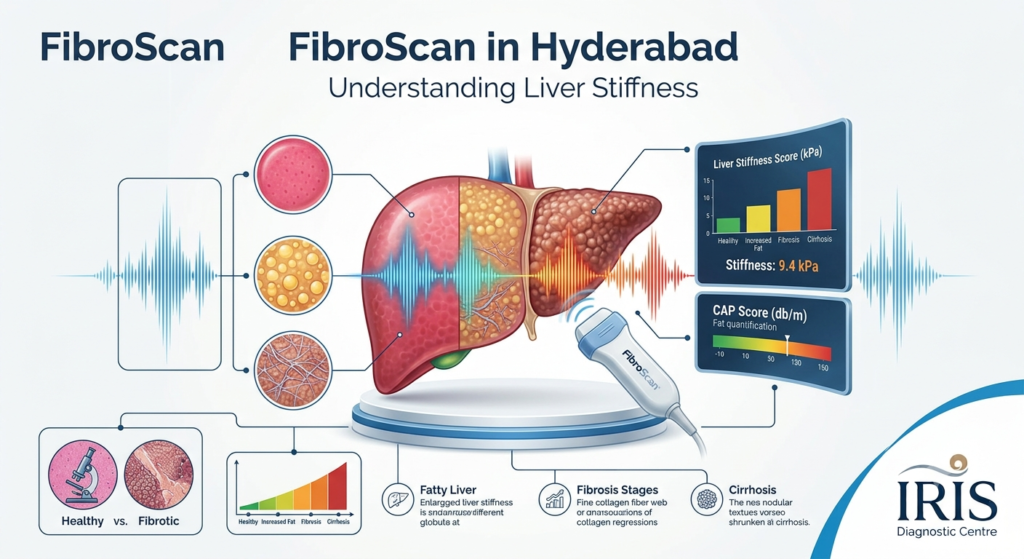
FibroScan in Hyderabad for Fatty Liver Assessment
Fatty liver refers to excess fat accumulation in the liver.
It can be associated with several metabolic factors, including obesity, diabetes, insulin resistance, high cholesterol, and high triglycerides.
FibroScan in Hyderabad can provide a CAP measurement that helps estimate liver fat.
The CAP measurement is useful information, but it should not be considered a complete diagnosis by itself.
Doctors may consider CAP along with blood tests, ultrasound findings, medical history, symptoms, and other relevant investigations.
Can Fatty Liver Lead to Fibrosis?
Not everyone with fatty liver develops significant fibrosis.
However, in some individuals, ongoing liver injury and inflammation can contribute to progressive scarring.
FibroScan in Hyderabad can provide liver stiffness measurements that may help healthcare professionals assess whether fibrosis requires further consideration.
Lifestyle management and appropriate medical follow-up may also be important depending on the individual’s health condition.
How FibroScan Supports Early Liver Monitoring
One of the useful features of FibroScan is that it can provide measurements without requiring an invasive tissue sample.
FibroScan in Hyderabad may therefore be considered when a doctor wants additional information about liver stiffness or estimated liver fat.
It can be useful for selected patients who need assessment or follow-up.
However, the test does not automatically replace other investigations.
Non-Invasive Assessment
Unlike a liver biopsy, FibroScan does not require removal of liver tissue.
FibroScan in Hyderabad uses a probe placed externally against the skin.
This makes it a convenient option for appropriate patients who require non-invasive liver assessment.
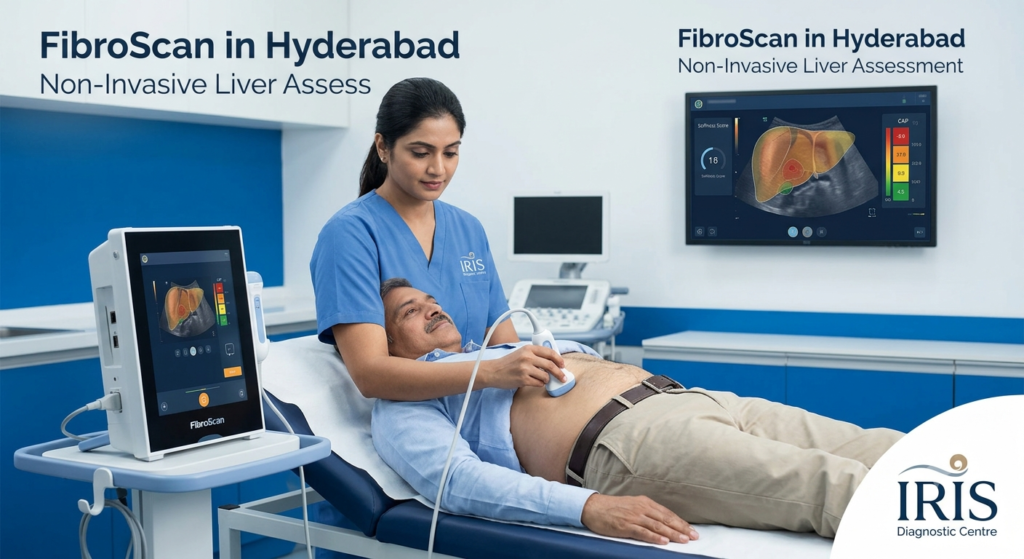
Quick Examination
The measurement process is generally short.
FibroScan in Hyderabad can therefore be convenient for patients who need an appropriate liver assessment without undergoing an invasive procedure.
The exact appointment duration can vary depending on preparation and the diagnostic centre’s process.
FibroScan in Hyderabad: Who May Benefit?
FibroScan is not necessary for every person.
A healthcare professional may consider it for people with suspected fatty liver, certain chronic liver conditions, abnormal liver-related blood tests, or relevant metabolic risk factors.
FibroScan in Hyderabad may also be considered when a doctor wants to monitor liver stiffness over time.
People With Metabolic Risk Factors
Obesity, diabetes, abnormal cholesterol, and high triglycerides can be associated with liver health concerns.
People with these conditions may benefit from discussing appropriate liver assessment with their healthcare professional.
FibroScan in Hyderabad can provide additional information about liver stiffness and estimated liver fat when clinically appropriate.
People With Known Liver Conditions
People who already have a diagnosed liver condition may require ongoing monitoring.
FibroScan in Hyderabad can be included in a follow-up plan when a healthcare professional believes repeated liver stiffness or fat assessment is useful.
The timing of repeat testing varies according to the patient’s condition.
Preparing for FibroScan
Preparation requirements can vary between diagnostic centres and individual patients.
Some healthcare providers may recommend fasting before the examination.
Before FibroScan in Hyderabad, patients should follow the specific preparation instructions provided by their doctor or diagnostic centre.
If you have diabetes or another condition that makes fasting difficult, inform your healthcare professional in advance.
Medication and Medical History
Do not stop prescribed medication unless your doctor specifically tells you to do so.
Inform the healthcare professional about relevant medications, previous liver investigations, and existing medical conditions.
This information can help provide appropriate context when the results are reviewed.
FibroScan in Hyderabad preparation is generally straightforward, but following instructions carefully can help avoid unnecessary confusion around the appointment.
FibroScan in Hyderabad: What Happens During the Procedure?
During the examination, the patient generally lies comfortably on their back.
The healthcare professional places the FibroScan probe against the skin over the liver area.
A small amount of gel may be used to help the probe make proper contact with the skin.
FibroScan in Hyderabad uses controlled vibrations to assess how waves move through liver tissue.
Several measurements may be taken during the examination.
The healthcare professional may ask you to remain still or follow simple breathing instructions.
Is the Procedure Painful?
FibroScan is generally non-invasive.
During FibroScan in Hyderabad, patients may feel mild pressure or a small vibration from the probe.
There is normally no surgical cut or tissue removal.
If you experience discomfort during the procedure, tell the healthcare professional performing the examination.
Understanding FibroScan Results
A FibroScan report may contain a liver stiffness measurement and a CAP measurement.
FibroScan in Hyderabad results should not be interpreted from one number alone.
Doctors may compare the findings with medical history, blood tests, imaging, symptoms, and other relevant information.
Different liver conditions can influence the way results are interpreted.
Liver Stiffness Measurement
Liver stiffness is commonly expressed in kPa.
Higher stiffness can sometimes be associated with increased fibrosis, but it does not automatically prove advanced liver disease.
FibroScan in Hyderabad provides a measurement that can contribute to fibrosis assessment.
Your doctor can determine whether the result is consistent with other clinical findings or whether additional testing may be useful.
CAP Measurement
CAP stands for Controlled Attenuation Parameter.
It is used to estimate liver fat.
FibroScan in Hyderabad can provide CAP information that may help healthcare professionals assess suspected fatty liver.
CAP should be interpreted as an estimate and considered together with other medical information.
FibroScan and Liver Fibrosis
Fibrosis develops when the liver produces scar tissue in response to ongoing injury.
The amount and progression of fibrosis can vary between individuals.
FibroScan in Hyderabad measures liver stiffness, which can provide information relevant to fibrosis assessment.
It is important to understand that FibroScan does not directly look at liver tissue under a microscope.
In certain situations, additional investigations may be required.
Why Fibrosis Monitoring Matters
Significant fibrosis can be associated with an increased risk of complications from chronic liver disease.
This is why appropriate assessment and follow-up can be important for selected patients.
FibroScan in Hyderabad may help provide non-invasive measurements that support clinical decision-making.
The results should always be interpreted in the context of the individual’s overall health.
FibroScan in Hyderabad vs Liver Biopsy
FibroScan and liver biopsy are different investigations.
A liver biopsy involves obtaining a small sample of liver tissue for microscopic examination.
FibroScan measures liver stiffness externally and can estimate liver fat through CAP.
FibroScan in Hyderabad may be preferred for appropriate non-invasive assessment, while biopsy may still be required in selected clinical situations.
| Feature | FibroScan | Liver Biopsy |
|---|---|---|
| Procedure type | Non-invasive | Invasive |
| Tissue sample | Not required | Required |
| Liver stiffness | Measured | Assessed through tissue findings |
| Liver fat | Estimated through CAP | Examined in tissue |
| Needle | No routine needle | Required |
| Incision | No | Invasive procedure |
| Recovery | Usually minimal | Recovery may be needed |
| Repeat assessment | Can be repeated when advised | Less suitable for routine repeated monitoring |
The choice of investigation depends on the patient’s condition and the healthcare professional’s clinical judgment.
Benefits of Early Liver Monitoring
Early monitoring can provide information that supports better-informed healthcare decisions.
FibroScan in Hyderabad may contribute to this process by providing liver stiffness and estimated liver fat measurements.
Supports Better Awareness
Learning about liver health can encourage people to pay attention to risk factors and lifestyle habits.
Provides Non-Invasive Measurements
FibroScan does not require a tissue sample for its measurements.
Can Support Follow-Up
Selected patients may undergo repeat assessments when clinically recommended.
Helps Inform Medical Discussions
The measurements can provide additional information that doctors can consider alongside other test results.
Lifestyle Habits for Better Liver Care
Diagnostic monitoring is only one part of liver health.
A balanced diet can support overall metabolic health.
Regular physical activity may help with weight management and cardiovascular health.
Managing diabetes, cholesterol, and other health conditions according to medical advice can also be important.
FibroScan in Hyderabad provides assessment information, but it does not replace healthy lifestyle habits or medical treatment.
Maintain a Healthy Weight
Excess body weight can be associated with metabolic conditions and fatty liver.
If weight management is recommended, it should be approached gradually and sustainably.
A healthcare professional or qualified nutrition expert can provide individualized guidance.
Stay Physically Active
Regular movement can support overall health.
Walking, cycling, swimming, strength exercises, or other suitable activities may be incorporated according to individual ability.
People with existing health conditions should discuss appropriate exercise plans with their healthcare professional.
Limit Excessive Alcohol
Excessive alcohol consumption can negatively affect liver health.
People with existing liver concerns should discuss alcohol use with their doctor.
Lifestyle recommendations should always be personalized according to the individual’s medical condition.
At IRIS Diagnostic Centre
Patients considering FibroScan in Hyderabad can discuss their liver assessment requirements at IRIS Diagnostic Centre.
Before the examination, patients can confirm preparation instructions, appointment requirements, procedure details, and report-related information with the diagnostic team.
The results should be reviewed by a qualified healthcare professional who can consider the findings alongside medical history and other investigations.
A diagnostic test is most useful when the results are properly interpreted and incorporated into an appropriate healthcare plan.
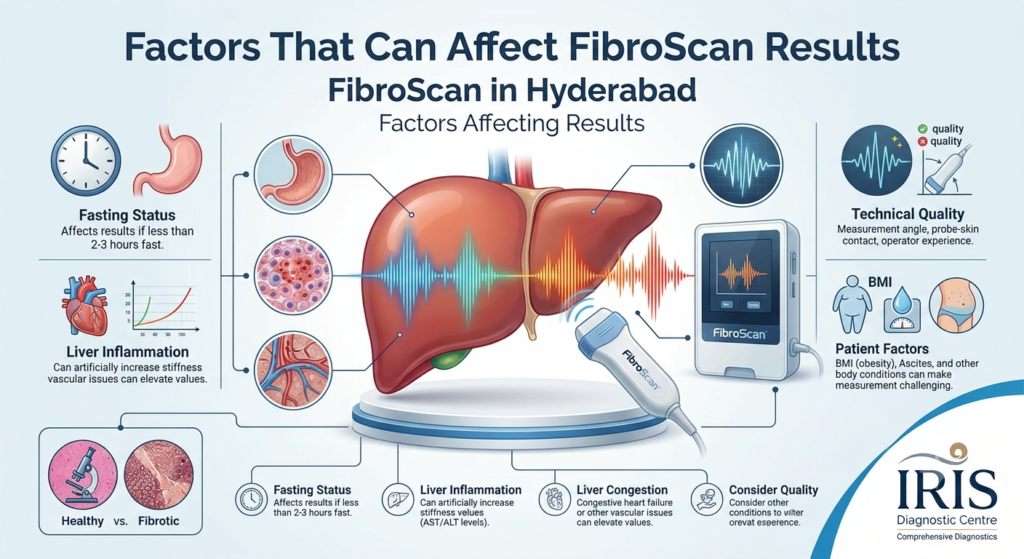
Factors That Can Affect FibroScan Results
FibroScan is a useful assessment tool, but results can be influenced by several factors.
Inflammation, liver congestion, recent food intake, technical factors, and certain patient characteristics may affect measurements.
FibroScan in Hyderabad results should therefore be reviewed by a healthcare professional rather than interpreted from an isolated value.
If a result is unexpected or does not match other clinical findings, the doctor may recommend additional assessment or repeat testing.
Can FibroScan Replace Other Liver Tests?
No single liver test provides a complete picture of liver health.
Blood tests can provide information about liver enzymes and other markers.
Ultrasound can provide structural information about the liver.
FibroScan provides liver stiffness and estimated liver fat measurements.
FibroScan in Hyderabad can complement other investigations rather than automatically replacing them.
Depending on the patient’s condition, a doctor may recommend one or more types of testing.
How Often Should FibroScan Be Done?
There is no universal schedule for everyone.
The appropriate frequency depends on the individual’s diagnosis, risk factors, previous results, treatment plan, and healthcare professional’s recommendations.
FibroScan in Hyderabad may be repeated when monitoring is considered clinically useful.
Patients should not schedule repeated examinations simply because they want to compare numbers without medical guidance.
A healthcare professional can determine when follow-up assessment is appropriate.
Frequently Asked Questions
1. What is FibroScan used for?
FibroScan is used to measure liver stiffness and estimate liver fat through CAP. It can contribute to the assessment of selected liver conditions.
2. Can FibroScan detect fatty liver?
It can provide a CAP measurement that estimates liver fat. The result should be interpreted alongside other medical findings.
3. Can FibroScan detect fibrosis?
FibroScan measures liver stiffness, which can provide information relevant to fibrosis assessment. However, stiffness can be affected by factors other than fibrosis.
4. Is FibroScan painful?
It is generally non-invasive. Patients may feel mild pressure or vibration when the probe is placed against the skin.
5. Do I need to fast before FibroScan?
Some diagnostic centres recommend fasting before the examination. Follow the specific instructions provided for your appointment.
6. How long does a FibroScan take?
The actual measurement is generally quick. Total appointment time can vary depending on preparation and the examination process.
7. What is CAP in a FibroScan report?
CAP stands for Controlled Attenuation Parameter. It is used to estimate liver fat.
8. What does a high liver stiffness measurement mean?
Higher liver stiffness can sometimes be associated with fibrosis, but other factors can also affect stiffness. Your doctor should interpret the result.
9. Can FibroScan replace a liver biopsy?
Not in every situation. FibroScan and biopsy provide different information, and the appropriate test depends on the clinical situation.
10. Can FibroScan be repeated?
Yes. Repeat testing may be recommended for selected patients who require ongoing monitoring.
11. Who may benefit from FibroScan?
People with suspected fatty liver, certain chronic liver conditions, abnormal liver-related tests, or relevant risk factors may be considered for FibroScan.
12. Does FibroScan diagnose every liver disease?
No. It provides specific information about liver stiffness and estimated fat. Other investigations may be necessary.
13. Can I interpret my FibroScan report myself?
It is better to discuss the report with a qualified healthcare professional because results need to be interpreted in the context of your overall health.
14. Is FibroScan suitable for everyone?
Not necessarily. Suitability can depend on individual medical and technical factors. A healthcare professional can determine whether it is appropriate.
15. What should I do after receiving my FibroScan report?
Discuss the findings with your doctor. Depending on the results, your doctor may recommend lifestyle changes, additional testing, treatment, or follow-up monitoring.
Final Thoughts
Early attention to liver health can support a more informed and proactive approach to healthcare.
Fatty liver does not automatically mean that significant fibrosis is present, but ongoing liver injury can contribute to fibrosis in some individuals.
FibroScan in Hyderabad offers a non-invasive way to measure liver stiffness and estimate liver fat when clinically appropriate.
The examination is generally straightforward, does not normally require tissue removal, and can provide useful measurements for selected patients.
However, FibroScan is not a standalone diagnosis. Results should be interpreted alongside blood tests, imaging, symptoms, medical history, and other relevant findings.
Healthy lifestyle habits, appropriate medical follow-up, and timely assessment can all contribute to better liver care.
For people with suspected fatty liver, known liver conditions, abnormal liver tests, or relevant risk factors, discussing appropriate monitoring with a qualified healthcare professional can help guide the next steps.
When recommended as part of an appropriate clinical plan, FibroScan in Hyderabad can be a valuable non-invasive tool for understanding and monitoring important aspects of liver health.
Call or WhatsApp: +91 81422 01122
Follow Iris Diagnostic on Instagram:https://www.instagram.com/irisdiagnostics/